Introducing the Institute for Driverless Transport
Self-Driving Insights started six months ago to fill a gap. I am now co-founding an organisation to bridge the ecosystem. Join our launch on April 9th

TLDR: I have co-founded a new Driverless Transport Research Institute. You can RSVP to our Launch Event on Thursday April 9th via our website or directly on Luma
There is a gap in the conversation about driverless transport in the United Kingdom. Self-Driving Insights launched six months ago to address exactly this. The question needed to shift from “when will autonomous vehicles arrive?” to “what happens next?” and “how do we make sure this technology benefits Britain as well as it could?”
Since then, there is a lot more certainty to point to.
Waymo has announced that it will begin London services by September this year. The company now operates in 10 US cities, up from 4 just six months ago, and is testing or mapping in over 30 more. Wayve will begin trials in London this year through a partnership with Uber. China’s Apollo Go is attempting to enter the UK market through Lyft, pending regulatory approval. Most recently, ComfortDelGro, Singapore’s largest taxi operator and a major global transport player, is exploring bringing robotaxis to London and expand beyond their existing MetroLine + Addison Lee offerings. On the continent, Tesla’s driver-assist FSD system is soon to be approved in the Netherlands, which would enable the technology to be accessed across the European Union. That’s really only a snapshot of the global developments, and it’s safe to say that the industry is accelerating.
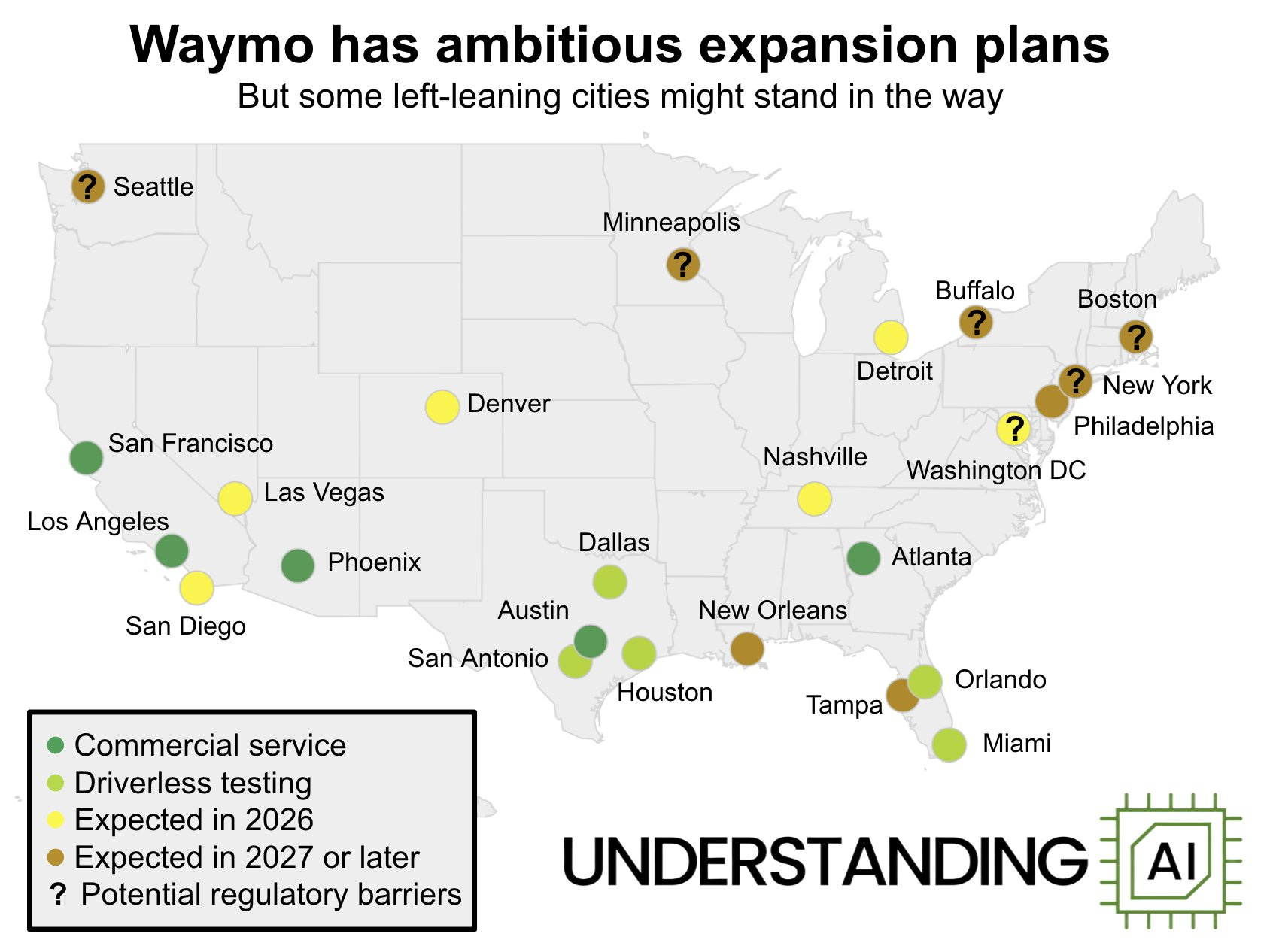
Lots has happened since this map has been published, just imagine another 5 dots or so
Over the last six months, SDI has aimed to bridge the gap between industry analysis, regulatory coverage, and safety and ethics debates. Nine posts have covered local government readiness, social implications of cheap autonomous transport, a misleadingly-framed statistic, autonomous bus procurement, and I even staked my own confidence against some predictions for 2026. But as these launches become more imminent, the distance between the people who need to be talking to each other is only growing wider. Whilst mobility conferences are talking about business cases and scaling, newspaper headlines are asking whether Waymo can handle a bit of rain. It feels, increasingly, like people are talking past each other.
The landscape as it stands
Britain has a few organisations working on autonomous vehicles already. Many do great work. TRL, Zenzic, PAVE produce excellent research and fund pilots across the country. But they are government-funded, and government-funded bodies do not, as a rule, go around telling the government when it has got things wrong. Then you have the trade bodies, the SMMT and ITS UK, who represent their members. There’s advocacy groups and independent consultancies, and of course the lobbyists of the AV firms themselves. What does not exist yet is something that can say uncomfortable things about the industry and the regulators without worrying about where next year’s money is coming from. Something independent, that can also bring in the people who have limited sway over the current conversation : drivers who face displacement, disability organisations, local councils about to take on new regulatory responsibilities, privacy advocates, consumers, businesses - everyone who’s day to day experience of our streets may change before they themselves get to use driverless technology. What’s needed is an organisation that’s representing the collective, including organisations and business who will leverage the technology to make the entire economy, and thus the nation wealthier. I believe it is time to ask new questions in public and expand the conversation beyond a newsletter.
Introducing IfDT
Today I am announcing the Institute for Driverless Transport, an independent research institute that I am co-founding to address these gaps.
The purpose of IfDT is to prepare policymakers, businesses, and communities for the consequences of driverless vehicles arriving on British roads. We are not funded by government grants or industry sponsorships. We have no commercial interest or preference in any particular technology, operator, or outcome. We believe that driverless transport can bring immense good to Britain, but that a lot of work has to be done to get the best out of tech.
Firstly, I’d like to invite you
This will be a cross-sector gathering, and deliberately so. We are inviting AV operators, transport planners, local council officers, representatives from disability organisations and drivers’ unions, people from insurance, logistics, property, and anyone who recognises that this transition will affect their work and wants to be ahead of it. The point is to put people in the same room who are not usually in the same room, and to start the conversations that need to happen before the first commercial robotaxi picks up a paying passenger in London.
If you work in transport, policy, local government, logistics, insurance, property, or if you are simply paying close attention to what is coming, you should be there.
We do three things. We produce research on questions that others are not asking. We advise organisations navigating this transition. And we bring together people who should be in the same room but currently are not. IfDT’s first public event takes place on Wednesday 9th April at 6pm at 1 Triton Square in central London. You can RSVP to our Launch Event via our website or directly on Luma.
What’s IfDT’s focus?
Our work focuses on four areas that we think are under-researched and deserve more attention than they are getting.
The first is productivity and economic opportunity. Driverless vehicles could transform logistics, unlock the nighttime economy, make construction more efficient, extend job access for disabled people and those without driving licences, and let people work while being transported. The economic implications reach well beyond the transport sector, but almost nobody is trying to map them.
The second is social impact. Cheap, flexible autonomous transport could change the texture of daily life in ways that are hard to predict but important to think about now. Children’s independence, elderly mobility, how communities are connected. Early deployment in the US is already generating evidence on some of this, but almost no UK-focused research exists.
The third is job displacement and fair transition. Hundreds of thousands of people in the UK drive for a living. Taxi drivers, private hire drivers, bus drivers, HGV drivers, delivery drivers. The transition will not happen overnight, but it will happen. And right now there is no independent body examining what a just transition looks like for these workers, which is a strange thing to be missing given how much of the country’s workforce is involved.
The fourth is geopolitics and security. Several of the operators seeking to enter the London market are headquartered in China. Their vehicles would collect detailed mapping and movement data on British roads. People within IfDT have worked with government on the security implications of this technology. We think this is a conversation that needs to happen in public, not only behind closed doors.
For students and graduates interested in transport, we will be launching a summer internship program in the coming weeks, and we welcome pitches for collaboration from anyone.
What happens to Self-Driving Insights?
SDI continues. The newsletter was always about implications, not industry news, not regulatory updates, but “what does this mean?” and “how could this play out?” That has not changed. What has changed is that SDI now sits within an institutional home that gives it broader reach and a wider platform. The analysis gets sharper. The conversations get bigger. The community that has been building around these questions over the last six months now has somewhere more permanent to go.
The road ahead
To understand the impact of driverless vehicles you have to make assumptions and do some difficult economic research. We will be working in openly, and contributing to a community that we hope will challenge us.
Subscribe to stay with us. Come to the event on April 9th. And if you want to be part of what we are building, get in touch. At tym@institutefordriverlesstransport.co.uk
The biggest shift in how people and goods move around Britain in decades is underway. It is also a time of enormous opportunity. Let’s make sure we are ready.
The Institute for Driverless Transport is an independent research institute. To learn more, visit ifdt.co.uk. To get in touch, email info@institutefordriverlesstransport.co.uk.