What does automated grocery delivery look like?
British supermarkets will adopt this technology first, once they make it work others will follow

The British supermarket sector is fast-paced and cutthroat, with supermarkets regularly declaring price wars on each other. Gone are the wholesome days when ‘grocery delivery’ meant a pint of milk on your doorstep. That old British experience faded away due to labour costs. This constant push to make savings is coming for grocery delivery once more, this time through the supermarkets themselves, and these changes will give us a glimpse of what’s to come for deliveries across the economy. Once supermarkets crack efficient autonomous delivery, how we receive clothes, pharmaceuticals, and everything else will be transformed. The problem is simple: time is money. Whether it’s an Ocado van or a Deliveroo cyclist, the majority of delivery costs come from human labour. This cuts into supermarket profits and limits delivery expansion, resulting in narrow delivery windows primarily on weekdays.
Spring 2026 will see self-driving cars take to British streets. Driverless private-hire vehicles will be available on the Uber app. This raises a natural question for supermarkets: could this technology be used to gain a competitive edge? What options exist for autonomous vehicles in grocery delivery? We’ll start with the immediate options, then explore the more imaginative possibilities this technology could enable.
Robotaxis for Delivery
This is already happening through the Uber Eats app. Waymo offers the service in Phoenix through both Uber Eats and DoorDash. The main difference is that customers have to walk to the car and collect groceries from the boot. This expensive option will emerge first because the technology already exists. The requirement to collect from the boot, however, limits its use for elderly or disabled customers who need door-to-door service.
More advanced versions will use better routing to serve multiple customers per trip. Eventually this model would be replaced by formalised partnerships between supermarkets and autonomous vehicle operators.
The partnerships model
Partnerships would let supermarkets avoid the costs of maintaining their own vehicle fleets. This is Ocado’s business model, one of the most technologically advanced logistics firms in the world. Ocado is no stranger to automation. They will find chase savings just like the rest of us. Robots on rails move grocery pallets in their warehouse centres, and they use sophisticated data techniques to maintain stock quality and schedule their delivery orders.
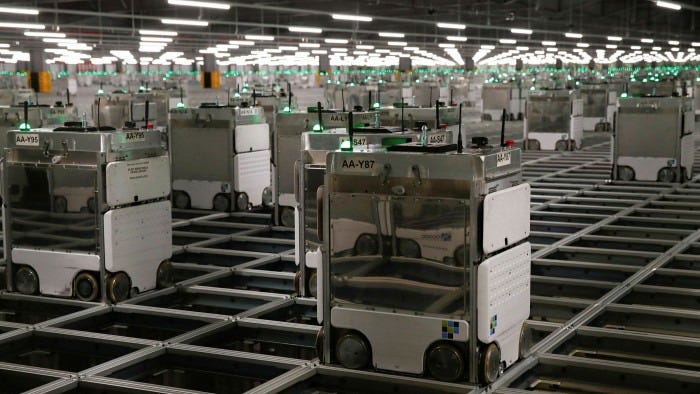
Ocado’s robots. Source: FT
Groceries travel far, they are shipped across continents or taken on trucks from farms to cities but the most expensive part of the process is the ‘last-mile delivery’. This is the final step of the parcels delivery process, from a transportation hub to its final destination such as a personal residence or retail store. It accounts for ~41% of grocery supply chain costs. So expect Ocado to acquire autonomous vans to handle batches of grocery orders soon to cut down on this cost.
Autonomous vans
Autonomous vans will change their appearance year by year. Initially they’ll look similar to standard vans, with friendly, modular shelving at the back which would allow customers to pick out their grocery boxes using an app or a code. Delivery windows would expand significantly. A midnight meal deal would become possible if you’re so inclined.
Supermarkets could also use these vans for stock transfers between warehouses and convenience stores. Eventually, purpose-built designs without driver seats would offer greater capacity.
Moving vending machines
Van designs will evolve further. They may become mobile pastry shops with warmed stock, offering variety right around the corner from your workplace. Maintaining a mobile vehicle is far cheaper than renting physical retail space. This would emerge first in London and other dense metropolitan areas. Unlike self-checkout systems, these would be protected from shoplifting. They could carry both frozen and chilled foods, appearing first at festivals and event grounds. Imagine a typical food truck alongside an unstaffed Greggs van at Glastonbury.
What about existing autonomous delivery robots?
The most advanced trial for autonomous grocery delivery in the UK is Starship, which serves Co-op. These small robots are cheaper to produce than a car or van and deliver directly to doorsteps, increasing convenience. This also enables for smaller orders to become profitable, human drivers require hourly wages and often return with empty vans. A small robot delivering a single bag of groceries can be profitable, while the same trip would lose money with a human driver.
However, they’re slower, more vulnerable to damage and theft, and cannot use roads. Unlike vans, they’re not useful for other purposes at night or when demand is low.
Their popularity remains uncertain. Speed could be the deciding factor. If they reach 30 miles per hour and gain road access, these robots could become the standard.
Personal Autonomous Vehicles for Grocery Collection
Personal ownership of autonomous vehicles may eventually enable a new model. The economics of grocery delivery would shift dramatically. You could send your personal AV to collect your shopping whilst you’re at work or asleep. This would feel like free delivery to customers. If your car would otherwise sit unused in the driveway, there’s no opportunity cost.
This model is simplest for supermarkets. They would need to prepare click-and-collect infrastructure, but they already have experience with this. The vehicle would pull up and identify itself, then a worker would load the boot. No middleman takes a cut, no delivery fee eats into margins or customer budgets.
For consumers, it eliminates the trade-off between convenience and cost. Delivery becomes effortless and free. For supermarkets, this could drive a surge in online orders without fleet maintenance costs or third-party fees.
In practice, all these models will coexist.
Autonomous grocery delivery will change other delivery experiences
Just as Argos set up the Click and Collect model in 2000 that British firms copied across the country, supermarkets will lead the way for the next change in retailer-consumer interaction. Once supermarkets find new methods of delivery that prove profitable, then other sectors of the economy will follow.
Many delivery experiences will remain the same in principle, but autonomous vehicles will make them more reliable, timely, cheaper and flexible. Night-time deliveries may become preferred due to lower traffic and the lack of need to pay for night wages. Perhaps small robots will bring grandma’s prescription every month at exactly the same time.
Some stores and restaurants may find it profitable to lean into a delivery model and downsize on their expensive real-estate. We already see this with London’s ‘ghost’ and ‘host’ kitchens, where existing and new restaurants focus their business around deliveries rather than in-person dining.
Autonomous vehicles will enable the future of deliveries. Different delivery models will emerge as retailers push for lower costs while customers demand convenience. The most convenient option may not always win; cost will matter too. The supermarkets pioneering these models today are not just reshaping grocery shopping. Whether it’s a midnight snack delivered by robot or your car fetching prescriptions while you sleep, the transformation begins with something as ordinary as milk and bread.
Read more:

